


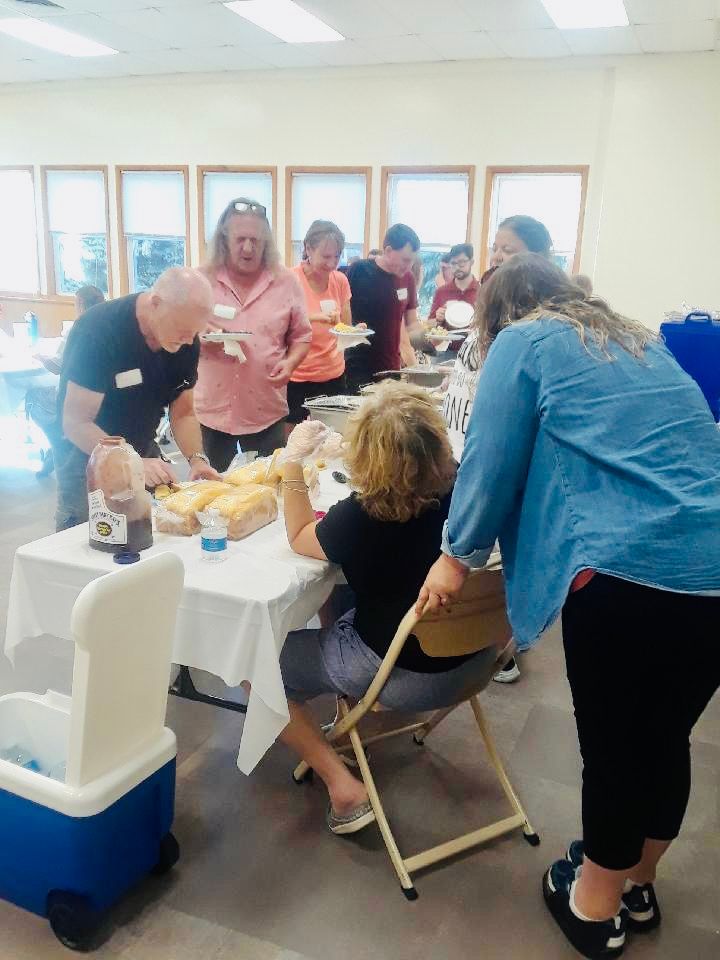


When I was right out of college, I packed three suitcases and moved from Texas to Washington, D.C. My parents were understandably concerned. They worried that I would be alone and have trouble finding my own way. I had made a few connections, and within a couple of weeks of arriving I was invited to rent a room in the home of a family. There's a particular transience to the D.C. area. Nearly everyone is from somewhere else, and this family was no exception. They remembered what it was like to be new, and they were particularly good at helping outsiders become insiders. When I moved in, I was given a chore. My simple task was unloading the dishwasher. It may seem odd, but it made me feel like part of the family. Before too long, their friends became my friends, and my friends became their friends. Our life together painted a different picture than the one we so often see in the midst of American suburban life. Like most families, they were busy people. Their schedule was already full. The thing is, this family didn't try to fit me into their schedule. They invited me into their life. In reality, their decision to open their home and their lives to me—and to others—made their schedule richer, not harder. During the years I lived there, they didn't throw a Christmas party. They threw a Christmas decorating party. They made the chili. The guests put the lights on the tree. For anyone who was far from home, the experience offered a blessed taste of home. Their hospitality welcomed us into a new kind of family. A Promise for Outsiders The prophet Isaiah tells us about a new kind of family—a family that welcomes the outsider into a promised land filled with hope. The nations will see your righteousness, and all kings your glory; you will be called by a new name that the mouth of the Lord will bestow. ... No longer will they call you Deserted, or name your land Desolate. But you will be called Hephzibah, and your land Beulah... (Isaiah 62:2–4) Isaiah is often called the "fifth gospel" because his words point so clearly to the coming of Christ. His prophecy was written across seasons of Israel's history—from strength, to exile, to restoration. Again and again, Isaiah reminds God's people that despite hardship, they will not be forsaken. The land will not remain desolate forever. God will give His people a new name, a new identity, and a renewed future. The promise of Israel, Isaiah says, is available to all. Those themes are instructive for us as we think about the life of the church. Like Israel, we have a collective memory. Many of us remember a time when it seemed like everyone we knew went to church. Now that time has passed, and it can feel as though we're living in exile. But exile changes us. It makes us stronger. We may dream of returning to the place where we once were, but that place never looks the same. The house we grew up in always feels smaller than it did when we were kids. We can't expect the church to look the same either. Like the prophet Isaiah, we remember that no matter the hardship, the people who are ushered into God's promise are given a new name and a new family. The promise of Israel is a blazing torch for all to see. When I say Israel, I don't mean simply the nation. I mean the promise: the promise of salvation, the promise that God delights in His people, and the promise that no matter how rejected or forgotten we may feel, God desires to give us a new name. The question for us is this: How is that promise made visible through our lives? From Outsiders to Family One of the most beautiful pictures of that promise is found in the story of Epiphany—the manifestation of Christ to people outside of Israel. The Magi follow the star to the home where Mary, Joseph, and Jesus are staying. Long before many recognized who Jesus was, outsiders were welcomed into His presence. I love celebrating Epiphany because, the truth is, we wouldn't be here without it. Which brings us back to family. The Magi are outsiders who are invited inside. They bring gifts to Jesus. Their story is a tangible reminder that the whole world has been invited into the celebration of God's covenant with His people. Think about it. Israel was once a closed family. There were rules about associating with outsiders. Through Jesus, that family was opened to the whole world. The promise that Abraham's descendants would be as numerous as the stars in the sky was beautifully echoed in the star that led the wise men to Jesus. Thankfully, Jesus' family didn't have the television up too loud when the wise men came to the door. Thankfully, they didn't wait until all the laundry was folded before welcoming them inside. There was something special about this family. They revealed something of God to the world, and the world couldn't help but notice. The same should be true of our families—and of the church as a family of families. If God's covenant with His people opened the door for outsiders to become family, how might God use our own families to invite others into His life? Three Ways to Help Outsiders Experience Family One of the gifts of the family who welcomed me into their home is that they showed me hospitality isn't complicated. It often begins with ordinary acts of openness. Celebrate holy days that tell the story of Jesus. Celebrate holidays in ways that invite neighbors into God's story. For Epiphany, invite friends to bring gifts for children in need. Let the children help the wise men journey to the manger scene. On the Feast of the Presentation, host a shower or blessing for a newborn in your neighborhood. Our celebrations can become opportunities for others to experience the welcome of God. Invite people into your life—not just your schedule. The family I lived with didn't try to squeeze me into an already busy calendar. They invited me into the life they were already living. Share errands with someone who's new in town. Invite neighbors over for a spontaneous Saturday breakfast—and don't clean the house beforehand. Hospitality isn't about creating perfect moments. It's about sharing everyday life. Pray with expectation. Before you leave for the grocery store, head out to dinner, or run errands, pray with your spouse, children, or housemates. Ask God to show you someone who needs encouragement or a blessing. People in our fresh expression have made this a regular practice, and they often come back with stories of God's work in the grocery aisle or around an ordinary meal. A New Name. A New Family. The promise of Israel is the promise of a new identity, a new family, and a new name. As we live into that promise ourselves, we also have the privilege of helping others discover that the Epiphany—the manifestation of God's power revealed in Jesus—is available to all. FROM THE ARCHIVES: Some ideas become more valuable with time. This article has been lightly updated to serve today's mission while preserving the author's original vision.

The brown leaves crunched beneath my boots as my friend and I hiked a section of the Appalachian Trail. Along the way, we passed two very different kinds of hikers. There were the weekend hikers—families with dogs and daypacks headed back to cozy cabins at day's end. And then there were the thru-hikers. These were people carrying everything they owned on their backs, committed to walking hundreds—sometimes thousands—of miles. They weren't taking a holiday from the trail. They lived for it. Their hearts were set on the journey. And thru-hikers don't stay in cabins. Instead, when they're not sleeping in tents or hammocks, they stay in simple trail shelters. These small, open-air structures provide protection from the wind and rain, but they're not designed for comfort. They're places where strangers become friends, stories are exchanged, meals are shared, and then everyone heads back onto the trail. That image has stayed with me ever since. Cabins are for people who want to take a holiday from the world. Shelters are for people who see the world as their mission. The same can be true of our church buildings. When Church Buildings Become Cabins One of the greatest resources an established church has is its building. For generations, church buildings have represented faithfulness, sacrifice, and the life of a congregation. They have been places of worship, celebration, comfort, and community. But as our culture has changed, many church buildings have quietly shifted in purpose. Instead of serving as launching places for mission, they've become places where the church retreats from the world around it. They protect us from the unfamiliar. They reflect the preferences of those who call them home. They disconnect from the neighborhood. They unintentionally communicate that church happens inside these walls rather than beyond them. In other words, many church buildings slowly become cabins. Cabin or Shelter? Having a church building isn't the problem. The question is what that building is preparing people to do. Does it primarily gather people who already belong, or does it equip and send disciples into the neighborhoods God loves? How do you know? Take this simple test: Do the majority of groups and ministries of your church meet in the building? (+1 for cabin if yes, +1 for shelter if no) Do any community groups utilize your building? If so, do you know the names of the groups’ leaders and something about them? (+1 each for cabin if no, +1 each for shelter if yes) Does your church kitchen cook food mainly for church members or community members? (+1 for cabin if church, +1 for shelter if community) If you started a new ministry that utilized your building in a way for people who are not connected to your church, would your congregation be mad? (+1 for cabin if yes, +1 for shelter if no) Do congregation members see themselves as owners or stewards of the building? (+1 for cabin if owners, +1 for shelter if stewards) Ask 3 people at the nearest grocery store if they have heard of your church. (+1 for cabin if 2-3 have not, +1 for shelter if 2-3 have) In outreach events, do congregation members focus more on talking to people who enter your church campus or selling things from your church campus? (+1 for cabin if selling things, +1 for shelter if talking to people) Does your church tell more stories (in worship Sunday School, etc) of local missions and missionaries or foreign missions and missionaries? (+1 for cabin if foreign, +1 for shelter if local) "Does your church building tend to serve more as a cabin—a place for members to congregate—or as a shelter—a place to deploy people into mission?" Turning Cabins into Shelters The good news is that cabins can become shelters. It doesn't happen overnight, but it does happen one faithful step at a time. Remove the Walls Not the physical ones—at least not yet. Begin by identifying the assumptions, fears, habits, or traditions that keep your congregation disconnected from the people around you. Disrupt Comfort Comfort isn't bad, but it can quietly become the enemy of mission. Ask what small changes might help your congregation become more attentive to the needs of the neighborhood than to maintaining the status quo. Tell Better Stories Share stories of everyday missionaries in your congregation—people building friendships, serving neighbors, and noticing where God is already at work. The stories we celebrate shape the church we become. Audit Your Building Walk through every room in your church with fresh eyes. What spaces are underused? Who from your community could gather there? Could you imagine homework clubs, recovery groups, artists, neighborhood associations, music lessons, or community meals filling those rooms throughout the week? Audit Your Community Meet with local leaders—a principal, nonprofit director, mayor, librarian, or business owner. Ask them one simple question: What are the greatest needs in our community right now? Listen carefully. God often reveals new mission opportunities through the voices of our neighbors. Prayer Walk Walk your property and your neighborhood with open eyes and open hearts. Pay attention to who is there, who isn't, and what the Holy Spirit may be inviting your church to notice. Visit The Chapel (the FX Prayer page) for a downloadable Prayer Walk Guide. Find Teammates Don't try to transform your church alone. Invite others to dream, pray, and experiment with you. Mission has always been a shared journey. Turn Existing Ministries Outward Rather than creating something entirely new, consider how an existing ministry could become more outward-facing. Could your annual dinner become a neighborhood meal? Could your building become a home base for people serving in the community rather than simply a destination? A Place to Be Sent In the time and place in society we find ourselves, church buildings can be a game-changer in re-orienting toward mission and the Kingdom of God. When a church building is a shelter where travelers can gather and then see their mission as back on the trail, it can amplify the evangelistic zeal and change the direction of an existing congregation. Cabin or shelter—which will be part of your church’s story? Cabin or shelter? Which story will your church tell? FROM THE ARCHIVES: Some ideas become more valuable with time. This article has been lightly updated to serve today's mission while preserving the author's original vision.

Dinner Churches and other fresh expressions often gather people with little or no experience with church—or whose only experiences have been distant or disappointing. Many are spiritually curious but unfamiliar with Scripture, making the Bible feel confusing or inaccessible. That's why we began looking for simple "entry points" into the story of what God is doing in the world. When the early Church faced a similar challenge, they told stories about Jesus—His life, teachings, miracles, death, and resurrection. That's what the apostles proclaimed throughout the book of Acts. It's what they used for evangelism and discipleship. They trusted the stories of Jesus to introduce people to Jesus Himself. Early church gatherings often happened around tables and shared meals. There, people heard simple, focused messages built around a single story from the life of Christ. Listeners were invited into Jesus' story, and over time, Jesus was invited into theirs. These messages were usually brief. There's a reason for that. As Paul reminds us, "the gospel... is the power of God that brings salvation to everyone who believes" (Romans 1:16). The first apostles trusted the stories of Jesus to carry the weight of their preaching. Creating a Bible for First-Time Readers We wanted a Bible that worked naturally in the Dinner Church context—one centered on the stories of Jesus found in Matthew, Mark, Luke, John, and Acts. It would provide an accessible place for people to begin without overwhelming them with study notes, cross-references, or explanations intended for experienced Bible readers. On a practical level, we also chose to remove the verse numbers. While helpful for study, they often interrupt the natural flow of the story and can feel unfamiliar to someone opening the Bible for the first time. We wanted readers to experience Scripture as a narrative that invites them in rather than as disconnected verses to analyze. We partnered with the American Bible Society to create this resource using the Contemporary English Version (CEV). We retained simple story headings while allowing the text itself to remain uncluttered. We called it Jesus Stories . Many Bibles are designed with study in mind, complete with notes and cross-references that serve mature readers well. Jesus Stories serves a different purpose. It removes many of those barriers so first-time readers can simply encounter the life of Jesus. Every guest who joins one of our Dinner Churches receives a copy as a gift, and our pastors preach from it every week. Why Stories Still Matter In a culture saturated with opinions, arguments, and endless content, stories still have a unique ability to disarm us. Rather than telling people what they should believe, the stories of Jesus invite them to encounter Him for themselves. Across our network of Dinner Churches, we've watched this simple practice awaken curiosity in people who never imagined church had anything to offer them. Week after week, guests tell us they find themselves thinking about the story long after dinner has ended. Those of us in the household of faith know why. Jesus continues revealing Himself through His own story. Over time, curiosity becomes conversation. Conversation becomes prayer. Prayer becomes a growing relationship with Christ. Three Parts of the Jesus Story Experience 1. Storytelling The speaker shares a seven-to-ten-minute message built around one story from the Gospels or Acts. Rather than offering a lengthy sermon, they read the passage and retell it in their own words, helping listeners enter the story naturally. 2. Personal Testimony The storyteller then shares how that particular story has shaped their own life. Perhaps it brought peace during a difficult season, inspired courage to take a next step, or became a source of healing and hope. The goal is simply to show how Jesus continues to meet people today. 3. Reflection and Prayer The gathering concludes by inviting everyone to reflect on what the story might be saying to them personally, followed by a generous prayer of blessing for those around the table. Why We Keep Coming Back to the Stories of Jesus We certainly teach from the whole of Scripture. Yet we intentionally allow the stories of Jesus to remain at the center of our preaching, discipleship, and evangelism. The rest of Scripture enriches and supports what we first discover in Christ Himself. More than ever, people are looking for authentic conversations about faith rather than polished presentations. Two thousand years later, the stories of Jesus are still introducing people to Jesus. We hope more churches and fresh expressions will rediscover the simple power of sharing His story. ------------------------------------------------------------- Putting It Into Practice: Telling a Jesus Story You don't need to be a preacher or Bible teacher to tell a Jesus story well. You simply need to know the story, allow it to shape you, and be willing to share it naturally with others. Step 1: Let the Story Get Inside You Choose a story from the Gospels. Start with a shorter passage, then work your way toward longer ones as you become more comfortable. Read the story several times—silently and aloud. Better yet, invite someone else to read it with you. As you become familiar with the story, reflect on these questions: What do I love about this story? What surprises or challenges me? What does this story reveal about God? What does it reveal about people? What invitation is Jesus extending to me? What will I do with this story—share it, apply it, or continue reflecting on it? Step 2: Let the Story Shape You As you spend time with the story, pay attention to how it is affecting you. Ask yourself: How does this story make me feel? Where is the tension or conflict? Which character do I most identify with? What details stand out to me or connect with my community? What questions does this story leave me with? Is Jesus inviting me to think differently, act differently, or trust Him more? Does this story make me think of someone I should share it with? Step 3: Let the Story Flow Through You Practice telling the story to someone else. Don't worry about memorizing every detail or trying to sound like a preacher. Simply tell the story in your own words while staying faithful to what Scripture says. As you prepare, consider: What is the main point I want people to notice? Which details help communicate that point? How would I naturally tell this story around a dinner table, over coffee, or in an everyday conversation? Am I telling it in a way that is understandable, accurate, and engaging? How might I encourage someone else to share this story with another person? Afterward, take a few minutes to reflect. What happened? What surprised you? If possible, invite your listener to respond to the questions from Steps 1 and 2. You may discover that God is already at work in ways you never expected.

I’m the granddaughter of a grower, a horticulturist, and a pioneer who supplied the Eastern United States with delicious fruit and beautiful plants for decades. Growing up, I learned early that fertile fields don’t just happen—you prepare them. You walk the boundaries, test the soil, remove the rocks, and pray for rain. You learn to trust that the seeds you plant will bear fruit in time. That rhythm—preparing, sowing, tending, and trusting—has shaped how I see the church and the mission of God. Jesus tells a story in Matthew 13 about a sower who scatters seed with generous abandon. Some falls on rocky ground, some among thorns, and some on good soil that produces an abundant harvest. The sower’s work is not to force the growth, but to prepare the soil and make room for the Spirit’s increase. I think that’s what we’re doing in the Fresh Expressions movement—cultivating the kind of soil where the gospel can take root in the hearts of people who might never find their way into a sanctuary. When the Fields Called Wesley In the spring of 1739, John Wesley faced his own “field moment.” His friend George Whitefield invited him to preach outside the walls of the church—literally, in the open air—to miners and laborers who would never set foot in an Anglican parish. Wesley was hesitant. He had been formed as an Anglican priest, faithful to the order and rhythm of the church. But when he saw the crowds who were spiritually hungry yet far from the pews, he wrote in his Journal: “At four in the afternoon I submitted to be more vile, and proclaimed in the highways the glad tidings of salvation.” — John Wesley’s Journal, April 2, 1739 Today, fewer than 1 in 3 Americans attend church services regularly, with only about 20% attending weekly and over half (57%) rarely or never participating in traditional religious gatherings. Meanwhile, nearly 30% of Americans now identify as religiously unaffiliated—a number that continues to rise each year. https://news.gallup.com/poll/642548/church-attendance-declined-religious-groups.aspx Yet, research consistently shows strong spiritual curiosity. For example, a recent study found that 66% of U.S. adults—even across generations—say they have made a personal commitment to Jesus that is still important today, and nearly a third of all Americans consider themselves “spiritually curious” despite not attending church. https://georgebarna.com/2025/02/most-americans-believe-in-a-supreme-power/ These trends echo the challenge that John Wesley faced—many people are unlikely to come inside church walls, but they remain deeply open to spiritual conversations and new expressions of Christian community outside traditional settings. That moment changed everything. Wesley didn’t abandon the Church of England; he sought to renew it from within by reaching those it had overlooked. His heart was not to create a rival church, but to extend the reach of grace—in his words to, “spread scriptural holiness throughout the land.” He knew the gospel could not be contained within the walls of even the most faithful parish. That is the beauty of the Methodist movement and perhaps what I most highly regard in Wesley’s theology. This important contribution to contemporary to Christian theogy is a both/and ness or as Wesley scholar Paul Chilcote refers to it “conjunctive theology” rather than either/or theology, that fleshes itself out in practical ways across our bridgebuilding tradition. Preparing the Soil Then and Now Wesley’s decision to take to the fields was not rebellion—it was reclamation. Both/And. He understood, as Jesus taught in Matthew 13, that the Word of God often meets resistance, but when the soil is ready, it multiplies thirty, sixty, even a hundredfold. The condition of the soil, in fact, did not prevent the Sower from scattering it generously if even perhaps, haphazardly. Wesley began organizing those who responded into small groups, or “societies, class meetings, and bands” where people could confess their sins, hear the stories and learn the ways of Jesus, and care for one another. Those early Methodists became gardeners of grace—cultivating holiness through community, discipline, and mission. That same pattern continues today in Fresh Expressions of church. We’re not creating something entirely new; we’re tending the fields Wesley and the circuit riders once rode through, believing again that God’s grace precedes us, is already at work, and wants to reach every person, in every place. We need only tend the soil of our communities. Whether it’s a dinner church, a running group, a recovery circle, or a coffee shop community, these expressions of church echo Wesley’s field preaching: going to where people are, not waiting for them to come to us. Sent in Pairs: Luke 10 and the Circuit Riders When Jesus sent out the seventy-two in Luke 10, He gave them clear instructions: “Go! I am sending you out like lambs among wolves… Do not take a purse or bag or sandals; and do not greet anyone on the road.” (Luke 10:3–4) He told them to rely on the hospitality of others, to speak peace, and to heal. The mission was mobile, relational, and dependent on the Spirit. Those instructions could easily describe the circuit riders of early Methodism. They traveled light, trusted God to provide, and sought out people who hadn’t heard the good news. They were sent to proclaim grace, form communities of faith, and nurture discipleship in barns, taverns, and on front porches. Quite frankly, this depended on the everyday Christian and the ministry of the laity. The only way the Methodist movement was able to move across the American landscape was due to the empowerment of the laity. Today is no different. The people called Methodist speak to this value in our connectional system. These fresh expressions of church are one more way we can empower and deploy our laity while recapturing our Wesleyan roots like the circuit riders who paved the way for us today. Where might God be calling you to cultivate the soil in your own community? Who are the people on the edges—the ones who aren’t coming to church but whom Jesus longs to reach? How might you go, as Wesley did, to where the people already are? The circuit riders’ lives were marked by both grit and grace. They rode hundreds of miles through harsh weather, often sleeping outdoors (and sometimes even on horseback), driven by a conviction that no soul should be out of reach of grace. Their legacy reminds us that innovation in mission is never about novelty for its own sake—it’s about love that refuses to be limited by buildings or boundaries. Today’s Fresh Expressions pioneers share that same resilient spirit, seeking out the people and places where grace permeates the soil and seeds beg to break through. Cultivating Fields of Renewal Wesley often said, “The world is my parish.” It was both a statement of boldness and humility. He didn’t mean he owned the world; he meant the world was entrusted to him as a field of mission. Every village, every person, every pub, every workplace—each was soil in which the Spirit was at work. Today, our fields might look different—online spaces, neighborhood parks, assisted living facilities, tattoo parlors, or CrossFit gyms—but the call remains the same: to cultivate soil where grace can grow. When we experiment with new forms of church, we’re not forsaking the old fields; we’re expanding the boundaries of the parish. A Call to Go and Grow As the granddaughter of a grower, I know that preparing soil is slow, patient work. You can’t rush a harvest. You have to tend to what’s beneath the surface, trusting that God is already at work long before the first green shoots appear. As a Methodist, I recognize the same pattern in Wesley’s movement. His ministry took root because he went to the people and nurtured what God was already growing. Fresh Expressions today are simply another season in that same story—another generation of Methodists called to go, to till, to tend, and to trust. “I look upon all the world as my parish; thus far I mean, that, in whatever part of it I am, I judge it meet, right, and my bounden duty to declare unto all that are willing to hear, the glad tidings of salvation.” — John Wesley, Journal, June 11, 1739 As Jesus said to His followers in Luke 10, “The harvest is plentiful, but the workers are few.” (Luke 10:2) The same is true today. The harvest fields around us are ripe—with people longing for belonging, meaning, and hope. The invitation is simple: Go. Prepare the soil. Trust that God is already scattering seed generously. For the “both/and” Wesleys, John and his brother Charles, there was no holiness apart from social holiness. Put another way, there was no holiness of heart apart from life. The linchpin, “The only thing that counts is faith working itself out through love.”-- Galatians 5:6 For the Wesley’s, holiness of heart and life is the goal toward which every Christian life should move. Ask God to show you one “field” near you where the soil might be ready. It could be a local café, a dog park, a recovery meeting, or a place you already spend time. Pray for the people there. Listen for their stories. Ask God how you might join God to bring peace and presence, not programs and plans. Because the same Spirit that sent Wesley to the fields is still sending us— into the world that is, even now, God’s parish.

I’m a Holiness, Pentecostal, Anabaptist. You won’t find that combination coming together very often anywhere, but I have found that all three streams work well within the Fresh Expressions movement. Some might assume that the Holiness/Pentecostal part makes sense with Fresh Expressions, but how can the Anabaptist part work? Afterall Fresh Expressions is a movement founded within the Church of England? How does Anabaptist belief and practice fit with that? Let’s remember that the Fresh Expressions movement took root in the fields of post-Christendom England just a few decades ago. Christian leaders among the church of England noticed that people were gathering in places outside the four walls of the church buildings to encounter God. Relational connections, networks of friendships were organically forming for mission in places of hurt, brokenness, marginalization. And outbreaks of the Spirit were happening. People were finding Christ in fresh and new ways. The church was happening among people that would never “go to church.” To their credit, the Anglican church leaders asked how can we support these movements and cooperate with what God was doing. Thus started a movement, the Mission-Shaped Church movement, as one of the founding documents was titled. It led to the Fresh Expressions movement in the UK and spread to North America. The Anabaptist movements have their origins 500 years ago in Europe, in the fields of post Christendom as well. In this case though, the Anabaptists were openly rejecting the Christendom alignment of church, state and culture. But like present-day Fresh Expressions, they represented the movements of Jesus happening outside the sanctioned four walls of the church and it’s hierarchies. As such, the two movements both started with Christians gathering outside the sanctioned practice and programs of the established church. And so we might expect that there’s much to learn from each other. Allow me to explore a few places where some of these learnings can happen. Christian leaders among the church of England noticed that people were gathering in places outside the four walls of the church buildings to encounter God. Post Christendom The medieval structures of the church, sponsored (and paid for) by the state, organized the church towards buildings, placing church authority in the offices of the priest/bishop, and coordinating the worship service and other programs of the church towards a uniform liturgy for all churches across the world. It was all part of Christendom. Anabaptists critiqued all of this, much of it for good reason. And this gave impetus for a reexamination of church outside the structures of the four walls of the Christendom church. In some ways, Fresh Expressions is doing today what Anabaptists have been doing for 500 years, the birthing of church expressions outside the walls and programming of institutional structure. Along with all this came an Anabaptist suspicion towards what had become the centralized leadership structures of the church and its proclivity towards hierarchy. Plagued with corruption, and abuse of power, Anabaptists left these medieval church hierarchies for more collaborative, organic forms of leadership. They sought to develop leadership “among” a people, not “over” a people. Five hundred years later, as we try to organize church outside the four walls of the church, what Fresh Expressions calls a ‘blended ecology,’ leadership will need to be organic in similar ways, doing the work of coalescing groups on the ground into the work of the Spirit. Anabaptists have some theology and history to offer Fresh Expressions in these tasks. But of course, it goes without saying, as with all movements, that over time institutions and bureaucracies get set in their ways. Five hundred years of Anabaptist history has shown how some of the best ideas on collaborative leadership, mutual and communal discernment, can go awry. Fresh Expressions has much to offer Anabaptists in this regard. Their work in training and developing new kinds of leaders can reinvigorate the Anabaptist work of developing leaders. Fresh Expressions can reinvigorate old histories, while Anabaptists can help in not repeating old mistakes. If Anabaptists have the history, Fresh Expressions has the energy. Anabaptists bring wisdom. Fresh Expressions brings the ”fresh” eyes. Together, I believe, a dialogue can ignite both for the work of Christ’s kingdom. If Anabaptists have the history, Fresh Expressions has the energy. Community and Discipleship Anabaptists see the church as more than a collection of individuals who gather to receive religious goods and service from the professionals. American churches have sometimes fallen into that trap. Fresh Expressions and Anabaptists alike resist that consumer approach to church. For Anabaptists, the community is central to the life of the believer. This Anabaptist focus wards off the consumerist tendencies of our culture. For Anabaptists, fellowship around a table at a potluck meal is almost sacramental. It is a special place to encounter Christ. The church is an alive organism of the Holy Spirit whereby we discern life together and the salvation made possible in Jesus Christ becomes real and lived together. Christianity is not a religion. Church is not a set of programs. It is a way of life given to us in Christ, lived out under His Lordship over a community, made possible by the Holy Spirit. Discipleship moves to the forefront for Anabaptists because Christians can no longer depend on the culture of Christendom to support Christian life. It must be the church community itself that generates culture and life sufficient to nurture our souls into faithfulness. And so the church as a community, alive with the gifts of the Spirit, eating meals at a table, discerning the teachings of Scripture, become a whole way of life that disciples believers into the Kingdom. There can be no consumerism here. This changes the way we think about ecclesiology. Anabaptists focus on practices, that shape beliefs into behavior. The questions we ask shift. When is a community just an affinity group, when is it mission, when is it discipleship? What is the core practices of discipleship and community that ground us in Jesus? As Fresh Expressions builds communities and practices for building communities outside the church, the wisdom of Anabaptists is helpful. The Anabaptist focus on practices, not only beliefs or programs, is helpful. And yet, as Anabaptists seek to avoid their own communities from becoming insular, coercive or sectarian, they can learn communal formation for mission all over again at Fresh Expressions. Together, Anabaptists and Fresh Expressions together, in dialogue, can ignite both for the renewal of the kingdom in our neighborhoods. The Kingdom Versus creedal formulas, Anabaptists tend to focus on Jesus first, his whole life, his proclamation of the Kingdom of God coming in his presence. The gospel is the whole life of Jesus, his victory over sin, death and evil. And so salvation hardly makes sense apart from Jesus’ preaching of the Kingdom of God, the inauguration of the Kingdom, and the living in that Kingdom now in anticipation of its future. Salvation can never be only personal, it is intensely social. And salvation can never be only social, it is intensely personal andn transformation as I personally follow Jesus and make Him Lord of my life. It is this full gospel, the gospel of Jesus Christ, and its inextricable link to the Kingdom that takes us beyond the individualist formulas. The Christendom forces in our history will always tempt us to turn salvation in Jesus into a formula Anabaptists of all streams can learn and be invigorated from the. But we must resist and learn the ways of calling people into something deeper. This is the heart of Fresh Expressions, it seems to me. Anabaptists can help Fresh Expressions with this call to something deeper. But sometimes Anabaptists can also get caught into an echo chamber. Over time our language and skills of communication lose the ability to engage the world outside the church. Fresh Expressions is ever pressing into how we can communicate the gospel of Jesus Christ and His Kingdom into broken places. Once again, I believe, that Anabaptists and Fresh Expressions together, in dialogue, can ignite a renewal of evangelism and witness to the kingdom in our neighborhoods. Courage for new adventures must take hold. We’re In New Territory Now In summary, if there’s one thing I have learned from both Anabaptists and Fresh Expressions, it’s that once we understand the social dynamics of the new post-Christendom cultures, our entire missiology and ecclesiology must shift. Old habits must die. Courage for new adventures must take hold. And God is calling us into these new fields of post-Christendom to do mission. And for this calling, I am so blessed to have partaken of both the Anabaptists streams and Fresh Expressions streams of theology and practice. I pray God brings these two great historical movements together more in the future to accomplish great things for the Kingdom of God in Jesus name.

Ever since the Baptist General Association of Virginia (BGAV) took responsibility for stewarding the Fresh Expressions movement (which originated in Great Britain) in the United States in 2012, Baptists from various streams of this vibrant and diverse family have caught its vision and ideals. Globally, Baptists are among the largest denominational families within the Reformation/Protestant tradition of the Christian Church. The Baptist World Alliance, for example, represents 53 million people in 138 countries and territories, with 283 member bodies. This does not include most of the Southern Baptist Convention (with the exception of BGAV and Baptist General Convention of Texas) and independent Baptists, and so it is fair to say that there are some 65-70 million Baptists globally. Baptists in general share several core convictions and missional attitudes that harmonize beautifully with the vision and mission of the Fresh Expressions movement. Commitment to the Great Commission Johann Gerhard Oncken (1800-1884), one of the founders of the Baptist movement in Germany and the rest of the European continent in the nineteenth century, was fond of saying that every Baptist was called to act as a missionary. This commitment to evangelism has been a core conviction of Baptists across the world, as they seek to participate in fulfilling the Great Commission that Jesus gave to his disciples (Matthew 28:18-20). In the twenty-first century, many Baptists have found the perspective and offerings of Fresh Expressions to be an exciting and innovative way to live out their missionary call. In the state I reside in, two-thirds of our residents will not be attending a traditional church service on Sunday mornings. New forms of community life and witness are urgently needed to reach these neighbors, many of whom are spiritually hungry but have no spiritual home. The Fresh Expressions new church plant that I attend (now a mature congregation) started out seeking to reach first and second-generation Koreans and other Asians who lived in the Princeton, NJ area. Now, some 17 years later, the church has welcomed and discipled people from a variety of cultural and racial backgrounds and is a truly global family. Small in size yet bold in vision, the fellowship has started several Fresh Expressions ministries and new congregations, from our locality outwards to several countries.
When Fresh Expressions in North America began more than a decade ago, people often tried to claim it for their own tribe. “This is an Anglican thing,” some said. A few years later, when Baptist churches and denominations began to join in, others concluded, “It’s for Baptists.” As the movement continued to grow, we began to hear, “Is this a Methodist thing?” Over the years, it’s become clear: Fresh Expressions isn’t owned by any one tradition—it’s enriched by all of them. Each ecclesial stream carries a treasure—something deeply rooted in its history, theology, and charism—that connects beautifully with the heartbeat of the Fresh Expressions movement. Fresh Expressions is not a new denominational brand, nor a replacement for existing congregations. It’s a movement of the Spirit calling the church back to its missionary identity—to join Jesus in the places we live, work, learn, and play. In every stream, from high church liturgy to grassroots revival, we find echoes of that same calling: the desire to be a church for the sake of others. Anglican Roots and the Gift of Mission-Shaped Church The earliest Fresh Expressions took shape in the Church of England, where leaders began noticing new forms of Christian community emerging on the edges, and began to not only make room for but encourage the church to move beyond her walls and plant the gospel in new soil. Anglicans remind us that mission is not an add-on to the church’s life; it is the church’s life. Their deep sense of sacrament and structure grounds the movement in continuity with the historic faith while sending it into the neighborhoods and networks of our day. The Baptist Gift of Evangelistic Passion Baptists quickly resonated with Fresh Expressions because of their long tradition of evangelism, discipleship, and congregational initiative. In many ways, Baptists embody the pioneering heart of the movement—equipping ordinary people to share the good news and start new communities where people are. Their gift reminds the wider church that every believer is a missionary and that the gospel travels best along relational lines of trust and care. Wesleyan Fire and the Holiness of Love From the Wesleyan and Methodist stream comes a fire that still burns for renewal. John Wesley’s early movement met people in fields, prisons, and workplaces—long before the term “missional church” existed. Fresh Expressions echoes that same impulse: to go where people are, practice a holiness that looks like love in action, and cultivate communities steeped in the grace of God that Wesley preached is already at work in the world before we are aware. The Wesleyan treasure is a faith both warm-hearted and socially engaged—a reminder that evangelism and justice belong together. Presbyterian Thoughtfulness and Connectional Strength Presbyterians bring a rich heritage of theological reflection and connectional leadership. Their gift lies in helping Fresh Expressions find both depth and sustainability. Through discernment, shared governance, and a commitment to equipping leaders, Presbyterians help the movement stay rooted while empowering innovation at every level. They remind us that imagination flourishes best within accountable, prayerful community. The Lutheran Treasure of Grace and Vocation Lutherans offer the gift of a grace-filled gospel and a deep theology of vocation. They remind us that the whole of life—our work, relationships, and communities—can be holy ground for ministry. In the Fresh Expressions movement, that conviction takes visible form: church can happen wherever God’s people live out their faith in ordinary places. Lutherans help us remember that our identity and mission flow not from our performance, but from God’s unmerited grace. The Catholic Gift of Sacrament and Incarnational Presence The Catholic tradition contributes a rich sense of sacrament—that God’s presence saturates the world and can be encountered in bread, wine, water, and neighbor. Catholic communities have long modeled incarnational mission through schools, hospitals, and neighborhood parishes. Fresh Expressions builds on that legacy, sending the church into the public square to embody Christ’s love in tangible, everyday ways. The Orthodox Treasure of Mystery and Transformation From the Orthodox stream comes a treasure of mystery, beauty, and transformation. In a world hungry for depth, the Orthodox vision of worship as participation in God’s divine life reminds the movement that mission begins in awe and ends in love. Their practices of prayer, fasting, and hospitality offer rhythms that sustain missional communities over the long haul. The Evangelical Gift of Passionate Witness Evangelical and Free Church traditions contribute a deep love for Scripture and a passion for sharing the good news of Jesus. Their emphasis on relational evangelism and personal transformation resonates deeply with the Fresh Expressions vision. They remind the whole church that new communities are born when ordinary people share faith naturally in the flow of life. Charismatic and Pentecostal Energy The Charismatic and Pentecostal streams bring a vital awareness of the Spirit’s power and presence. Their treasure is a living expectancy—that God is still speaking, healing, and sending the church into the world today. Fresh Expressions draws energy from that openness to the Spirit, recognizing that mission is not just a strategy but a movement of God’s grace breaking into everyday life. The Anabaptist Witness of Everyday Discipleship The Anabaptist tradition contributes the gift of community and simplicity. Their long-held vision of the church as a countercultural people—embodying peace, justice, and radical discipleship—resonates deeply with the Fresh Expressions vision. They remind us that the gospel is not only proclaimed but lived out in small, shared, everyday acts of love. The Restorationist Desire for Unity and Simplicity Restorationist and Holiness movements bring a longing for simplicity and unity—to be the church that reflects the heart of Jesus rather than the boundaries of denominations. Their treasure lies in a humble return to the essentials: Scripture, discipleship, and community. Fresh Expressions echoes that vision, calling all streams of the church to join together in God’s mission with open hands and open hearts. A Shared Mission, A Richer Church Each of these treasures—sacrament and structure, evangelism and discipleship, renewal and justice, grace and vocation, mystery and transformation, Spirit and simplicity—adds depth to the mosaic of Fresh Expressions. Together, they reveal that this movement isn’t a departure from our traditions but a rediscovery of their truest gifts. As we continue to explore the “ecclesially flexible” nature of Fresh Expressions, we hope every denomination, network, and congregation will see themselves in this movement. The Spirit is stirring across traditions, calling us not to abandon our histories but to live them more fully—for the sake of those who have yet to experience the love of Christ. Over the next season, we will be highlighting leaders from some of these traditions as they reflect upon the ways their distinct tradition aligns with the heart and the vision of Fresh Expressions. We hope this series encourages you to look more closely at the Fresh Expressions approach to mission and discover how it can help you live out your history and calling in your local context and congregation. And we trust that when the treasures of each stream flow together, the whole church becomes more activated, more creative, and more faithful in joining God’s mission in the world.

When we started Fresh Expressions in North America over a decade ago, people often commented, “this is an Anglican thing.” After a year or two of mostly Baptist churches and denominations showing interest, some said, “This is for Baptists.” Then it was Presbyterians. Later, it was Methodists. Over the last 11+ years, there have been portions of the church who thought Fresh Expressions wasn’t for their part of the church. But as we continued to share this vision with each of those detractors, it only helped me realize that Fresh Expressions is really for the whole church.

Our church is experimenting with a hiking initiative that may even grow into a new expression of Church. We're invested enough in the possibility that we want to provide training and support for it. But we're not training our pastor. We're investing in one of our church members. In Southwest Virginia, where our community is located, the landscape is rich with hiking trails, including numerous access points to the Appalachian Trail, all within a short drive. Despite the great outdoors being literally in my backyard, I do not frequently engage in hiking. Yet, it’s not difficult to recognize through social media posts and conversations catching up about one’s weekend that a significant number of people cherish the hiking experience. Furthermore, a lot of people find that spending time in nature and amidst creation holds significant meaning and serves as a pathway for connecting with God. The idea of organizing reflective prayer hikes for our community didn't come from our church's paid pastoral staff. It came from one of our members and an avid hiker, Emma. When Emma proposed the idea, it was an easy "yes." She had recognized the outdoor interests of many in our region, and she was keen to lead and innovate and see if her spiritual approach to the outdoors captured the interest of others. "Permission Giving" is Leadership What separates Jesus-followers whose sense of mission leads them to start new things from other kinds of entrepreneurs and initiators is a three-pronged approach to listening: listening for the Holy Spirit, listening to the needs of our neighbors, and listening alongside our church community. Listening is a pivotal element for a pastor or church leader who hopes their congregation will embrace new approaches to church. Much of our ministry begins with the simple yet profound act of listening, setting the stage for deeper engagement and understanding. But making listening a primary leadership strategy is not always natural. Church leaders have the distractions of various ministry activities and can often feel the pressure to act swiftly—and sometimes to do it all themselves. If a church is going to try new things, leaders may need to change their approach from doing everything to becoming permission givers. This means paying close attention not only to the voices of our leaders and congregation but also to the wider community we serve. It means continually asking, "Where is God already at work in our environment—and who is noticing?" When Emma suggested the idea of reflective hikes, she was demonstrating her own experience of listening to the needs of her community and for the voice of the Holy Spirit. As permission-giving leaders, our job is to listen to our Emmas. And we show that we are listening by doing more than simply saying, "Sure, go ahead." We help them develop their ideas. We encourage experimentation. We connect them with resources, relationships, and training that can help something small take its next faithful step. The First Hikes The first hike began with Emma making a simple invitation to friends and fellow hikers: "I’m excited to explore something new through a reflective prayer hike and would be delighted for you to join." The invitation made it clear that she was asking others to help her experiment with providing an opportunity to engage with nature, reflection, and spiritual connection. The hike started with a time of centering—eyes closed, deep breaths, releasing distracting thoughts—while picturing God present as the hike began. From there, hikers stopped about every ten minutes for discussion. They were also prompted to pay attention to each of their five senses and consider the ways God was interacting with them during the hike. Another hike offered time for silent personal prayer followed by an invitation to notice new life springing forth in the surroundings and consider where God might be bringing new life. On the way down, hikers shared where they had been wanting to see God's grace and participated in a communal response from Psalm 139. These initial experiences were well received and encouraged Emma to keep experimenting. And that raises an important question for those of us in church leadership: What happens after we say yes? What Training Do Others Need? Our experience with Emma has led me to reflect on the importance of listening in my own pastoral leadership. It makes me wonder what our churches would be like if leaders focused more on being permission givers—not only saying "yes," but also providing opportunities for others to receive training, development, and encouragement. I've tried to become more attentive to the opportunities that "come across my desk" (or, more accurately these days, across my screen). I recognize that I don't need to say "YES!" to each one. But I also don't need to immediately delete them. Instead, each webinar, gathering, training, or learning opportunity gives me another question to consider: "Is this opportunity a fit for someone else?" Maybe there's an artist in your congregation wondering what creativity has to do with mission. Maybe someone loves gathering people in coffee shops. Maybe there's a person who naturally connects with older adults, college students, runners, gardeners, or neighbors around a dinner table. They may never call themselves a pioneer. They may simply have noticed something—and wondered, What if? One of the roles we can play as pastors and church leaders is to notice them noticing. That's one reason opportunities like Fresh Expressions Incubators can be so valuable. They create space for people with an idea, interest, or emerging experiment to learn from practitioners, explore a particular context, bounce around ideas, and imagine what a next step could look like. And sometimes the person who needs that opportunity isn't the pastor. Permission-giving leadership means recognizing that we don't have to be the ones with every idea, lead every experiment, or attend every training. Sometimes our most important leadership happens when we recognize what God may be stirring in someone else and say: "Yes. Let's see where this could go—and how we can help you get there." Perhaps your permission-giving is what opens the door for someone in your congregation to take a next step—like joining a Fresh Expressions Incubator and exploring where God might be leading them.

The Reformed Tradition